
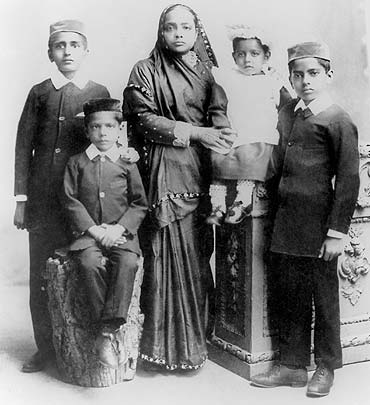
An eternal father’s forgotten son – Harilal Gandhi – II
The book by C.B Dalal notes that in 1926, Gandhi had surrendered all rights to his ancestral house at Rajkot. The partition deed that was prepared showed Gandhi’s elder brother Lakshmida’ son Samaldas and another brother Karsandas’ son Jethalal, as the new owners. Around this time Harilal was in dire financial need and borrowed about ten thousand rupees from the Thakore Saheb of Rajkot.
When the new owners Samaldas and Jethalal wanted to sell the house, the amount lent to Harilal was accounted as outstanding, and the transfer of the property could not be effective. Meanwhile there was also some confusion in the partition deed requiring all claimants to clarify that they had surrendered their rights.
Jethalal complained to Gandhi that Harilal had declined to give a written commitment to forgo his right to property. Harilal immediately went to Rajkot, and clarified that the ten thousand rupees was only borrowed on his sole responsibility. He also clarified that he had no claims on the property, thus paving the way for its sale.
Devadas Gandhi, the brother of Harilal recounts that, despite the conflict with his father, Harilal had great respect for his father, defending his father outside the circle of family and friends. Harilal travelled a lot by train, almost as much as that of Gandhi. People from all communities and walks of life cared for him, not minding his misadventures.
Devadas philosophically adds that Harilal had something unique in him that drew people to him and made them look beyond his failures. He always held his head high and never seriously thought of injuring anyone. The brother notes that a remarkable trait in Harilal was his willingness to suffer the consequences of his actions.

Harilal though did not read much, was careful enough to chose what he would read. The Gita Rahasya, Lokmanya Tilak’s treatise on the Bhagawat Gita was always with him. He carried a copy of it wherever he went. Even if he didn’t have a shirt, he would carry a copy of it with him. So affectionate is Devadas to his brother that he says, “If I can find the particular copy which he used, I shall keep it with my other treasures”.
Recounting her short association with Harilal, his daughter-in-law Sarawati Gandhi says, “The little time I spent with him, convinced me that he was not at all a bad man. I regard him as the most intelligent of the four sons of Bapuji (Senior Gandhi). He was very humorous, very generous and very hospitable, yet he was attached to drinking”. The daughter in law seems to ask, “Why, who is to be blamed?”.
The daughter- in-law recounts that she saw him for the first time as Abdulla Gandhi prior to her marriage, wearing a red muslim cap with a tail at the top. Her future father-in-law seemed to ignore her while talking affectionately to his son, Kantilal Gandhi. Sarawati speaks of her close association with Harilal saying, “He loved me as his own daughter and I too loved him as my own father”. On Harilal’s reluctance to stay with them, she says, “I was worried about him being alone and uncared. But we were helpless, How much I wish he stayed with us till the end”.
The book recounts another incident when Gandhi and Kasturba were traveling by the Jabalpur Mail. As the train reached Katni station, a call “Kasturba Mata ki Jai” was heard. On looking out through the window saw Harilal standing on the platform. His once strong physique was now too weak, and all his front teeth were missing.
Taking an orange from his pocket, he gave her and said, “Ba, I’ve brought this for you”. When Gandhi asked him if he would like to come with them, he refused saying that he had only come to meet Ba. When his mother asked him where he got the orange from he said, “Does it matter where I got it from?. I have got it for you. I begged for it”.
The most important part of the book is perhaps the appendix 1, Harilal’s semi public letter, where he address the core differences with Gandhi in the form of a letter. “Our differences are not of recent origin. We have had differences for the past ten years. You are convinced that you have given me and my brothers the necessary education. I believe with your preoccupations and engagements, you have unintentionally paid us no attention at all. Because of your desire to provide us education and care, you experience an illusion of having done it”.
The core issue clearly seems to be education. Speaking for his brothers, Harilal mentions, “For ten years now I have been crying and pleading with you, but the worm is insignificant for the wasp. You have never considered my sentiments. I believe you have always used us, me and my brothers, as weapons”.
Saying that his father dealt with them like a ringmaster would deal with animals in a circus, he added that public are naturally disappointed with them (Harilal and his brothers). It is very sad to know the conclusions, drawn by poet Rabindranath Tagore, subsequent to his first meeting with the four sons. The poet had described them as ‘ignoramus’, and this in turn was conveyed to them by the senior Gandhi.
Harilal Gandhi is very likely to have endured a life of pain and pathos, which like any other aspects of his life, is hardly known. The reminisces by close relatives, and derived conclusions as depicted by the book show a different Harilal, one that instantly draws respect and admiration. Perhaps could it be that; when individuals increasingly contribute to the society beyond a threshold, they do it at the cost of their families?. It is possible that the father Gandhi as described by son Harilal, could have unintentionally paid no attention to them. Perhaps in the making of its father, the nation had caused him to neglect his own son.


